Artificial intelligence is rapidly transforming the world, and Google is at the forefront of this revolution. Google Stitch AI, while not a single, publicly branded product, represents a collection of Google’s advanced AI capabilities often woven into various existing services and platforms. This article delves into what “Stitch AI” conceptually embodies, its potential applications, and how it might be used in different contexts.
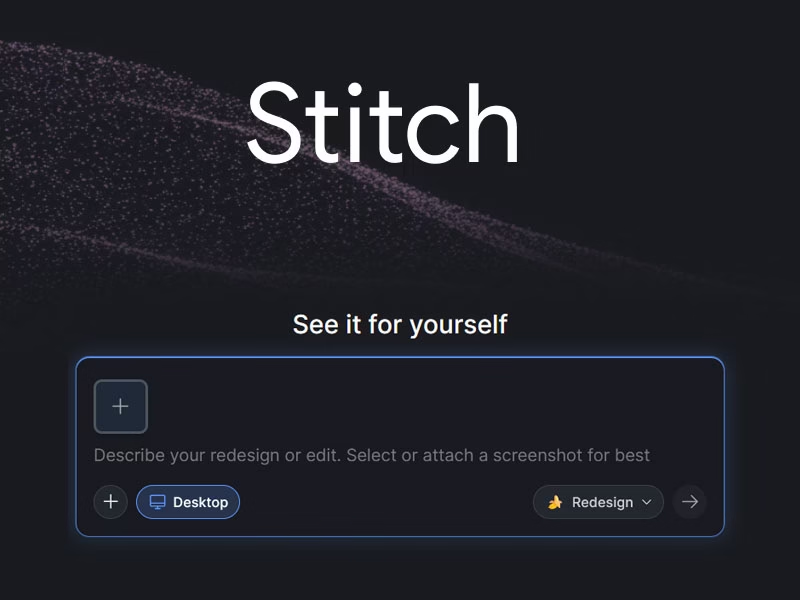
Table of Contents
Understanding the “Stitch” Concept in Google AI
The term “Stitch” in the context of Google AI isn’t usually associated with a specific, standalone product. Instead, it more accurately reflects Google’s approach to integrating and weaving AI functionalities across its diverse suite of services. Think of it as the process of “stitching” together different AI models and techniques to create more robust and intelligent solutions.
This integration often involves combining different AI models to achieve a specific outcome. For instance, a Google service might use natural language processing (NLP) to understand user input, computer vision to analyze images, and machine learning to personalize the experience. These different AI capabilities are seamlessly “stitched” together to provide a cohesive and intelligent user experience.
Key AI Components Google Integrates
- Natural Language Processing (NLP): Used for understanding and processing human language, powering features like Google Assistant, Google Translate, and Smart Compose in Gmail.
- Computer Vision: Enables machines to “see” and interpret images and videos, used in Google Lens, image search, and object recognition.
- Machine Learning (ML): Allows systems to learn from data and improve over time, used for personalized recommendations, fraud detection, and spam filtering.
- Deep Learning (DL): A subset of ML that uses artificial neural networks with multiple layers to analyze data with great complexity, essential for image and speech recognition.
- Generative AI: Creates new content, such as text, images, or code, based on learned patterns from existing data, like Bard and Imagen.
Potential Applications of “Stitched” AI in Google Services
The possibilities for integrating AI across Google’s services are vast. Here are some examples of how “Stitch AI” could manifest in different areas:
Enhanced Search Experience
Google Search is already heavily reliant on AI, but “Stitch AI” could take it to the next level. Imagine:
- Deeper Contextual Understanding: Search results that understand the nuances of your query, even if it’s vaguely worded.
- Personalized Recommendations: Suggestions based not just on your search history, but also on your broader interests and activities.
- Visual Search Enhancements: The ability to search for objects within images, even if you don’t know what they’re called.
Improved Productivity Tools
Google Workspace (Gmail, Docs, Sheets, etc.) could benefit immensely from “Stitch AI”:
- Smarter Autocompletion: Autocompletion that anticipates your next sentence, not just the next word.
- Automated Content Creation: AI that can generate drafts, summarize documents, or create presentations based on your specifications.
- Real-Time Collaboration Assistance: AI that can suggest improvements to your writing, flag potential errors, or translate languages in real-time.
More Intelligent Assistant
Google Assistant could become even more helpful and proactive:
- Anticipatory Actions: The Assistant proactively offering help based on your routine and context (e.g., reminding you to leave for a meeting based on traffic conditions).
- Natural Conversation: More fluid and natural conversations with the Assistant, without needing to use specific commands.
- Seamless Integration with Other Services: The Assistant seamlessly integrating with other Google services and third-party apps to provide a unified experience.
Advanced Healthcare Applications
Google is investing heavily in AI for healthcare, with potential applications including:
- Early Disease Detection: AI algorithms that can analyze medical images to detect diseases like cancer at an early stage.
- Personalized Treatment Plans: AI that can analyze patient data to recommend personalized treatment plans based on their individual needs.
- Drug Discovery: AI that can accelerate the drug discovery process by identifying potential drug candidates and predicting their effectiveness.
Comparing Google’s AI Approach to Competitors
While “Stitch AI” isn’t a direct product, it represents Google’s overall philosophy of integrating AI. Here’s how Google’s approach compares to some of its competitors:
| Company | AI Focus | Key Strengths | Potential Weaknesses |
|---|---|---|---|
| Integration across diverse services | Breadth of services, advanced research, large datasets | Complexity of integration, potential for bias | |
| Microsoft | AI-powered productivity and enterprise solutions | Strong enterprise focus, integration with Azure cloud, investment in OpenAI | Reliance on OpenAI, potential for vendor lock-in |
| Amazon | AI for e-commerce and cloud services | Dominant e-commerce platform, leading cloud provider (AWS), focus on practical applications | Ethical concerns around data privacy and surveillance |
The Future of “Stitch AI”
As AI technology continues to evolve, we can expect “Stitch AI” to become even more sophisticated and pervasive. Google is likely to focus on:
- Explainable AI (XAI): Making AI decisions more transparent and understandable.
- Federated Learning: Training AI models on decentralized data sources, protecting user privacy.
- Responsible AI: Developing and deploying AI systems in a way that is ethical, fair, and accountable.
FAQ: Understanding Google Stitch AI
What exactly is Google Stitch AI?
Google Stitch AI isn’t a specific product, but rather a concept representing Google’s strategy of integrating various AI models and techniques across its different services to create more intelligent and seamless user experiences.
Where can I find Google Stitch AI to use?
You won’t find a standalone product called “Google Stitch AI.” Its capabilities are integrated into existing Google products like Search, Gmail, Google Assistant, and others. You implicitly use it when you interact with these services.
How is Google Stitch AI different from other AI tools?
The key difference lies in the integration. Google aims to “stitch” together different AI models to create cohesive solutions, rather than offering isolated AI tools. This approach allows for more nuanced and powerful applications.
What are some examples of Google Stitch AI in action?
Examples include Google Search understanding complex queries, Gmail’s Smart Compose predicting sentences, and Google Assistant proactively offering help based on your routine. These features combine multiple AI technologies seamlessly.
What’s the future of Google Stitch AI?
The future of Google Stitch AI involves making AI more explainable, responsible, and privacy-preserving through technologies like Explainable AI (XAI), Federated Learning, and a focus on ethical AI development. Expect even more seamless integration into Google’s services.
Unleash Your Inner AI Innovator with Google AI Studio: A Comprehensive Guide
Follow us on Twitter